
• Skip to primary navigation
  • Skip to main content
  • Skip to primary sidebar
Nancy Parker Brummett

Nancy Parker Brummett

Author Writer Speaker

  • Home
  • Meet Nancy
  • Books by Nancy
  • Blogs
    • Back Porch Break
    • Take My Hand Again
  • Speaking
  • Contact

Take My Hand Again

What I Learned from Two Old Women

May 21, 2012 by Nancy 3 Comments

Occasionally you read a book that stays with you long after you close the cover for the last time and place the book on the shelf (or delete it from your reader!).  So it is with a small volume I read with my book group not too long ago, Two Old Women by Velma Wallis.

A poignant account of aging is found in this short but powerful book. Based on an Athabascan Indian legend passed along for many generations from mothers to daughters of the upper Yukon River Valley in Alaska, it’s the inspirational tale of two old women abandoned by their tribe during a brutal winter famine. The chief regrets having to leave the old women behind, as do the families of the elders, but the decision is made that they must be abandoned so the others can move on.

What happens next should encourage all of us who aren’t as young and capable as we once were. “We have learned much during our long lives,” said one of the women named Sa’. “Yet there we were in our old age, thinking that we had done our share in life. So we stopped, just like that. No more working like we used to, even though our bodies are still healthy enough to do a little more than we expect of ourselves.”

Her slightly older friend, Ch’idzigyaak, listened carefully to her friend’s revelation as to why they were left behind.

“Two old women,” Sa’ continued. “They complain, never satisfied. We talk of no food, and of how good it was in our days when it really was no better. We think that we are too old. Now, because we have spent so many years convincing the younger people that we are hopeless, they believe that we are no longer of use to this world.” And then she lays down a challenge for herself and her friend: “If we are going to die anyway, let us die trying!”

By the end of the book, the two old friends have done more than try—they have survived and survived beautifully. So successful are they in employing all the wisdom and skills they accumulated over their many decades that, when they are eventually reunited with the tribe, they have pelts and food enough to share with those who walked off and left them to die in the cold!

The lesson is one we can apply to helping our elders. Without unmercifully nagging them into doing everything they once could do, we need to gently encourage them to do that which they still can. How often we hear of elders dying shortly after retiring simply because they felt their life was over. Likewise, older adults can simply give up once they move into an assisted living facility if those around them treat them as if they can’t do anything for themselves anymore. Better to err on the side of encouragement than discouragement. Wait until you are sure help is needed before jumping in to button a blouse, tie a shoe, or make a bed.

And the lesson for those of us who aren’t quite there yet? Stop moaning about what we can’t do as well anymore and keep doing everything we can! Then, like the characters in the Alaskan legend, we’ll do far more than survive–we’ll survive beautifully!


Filed Under: Take My Hand Again Tagged With: aging, Alaska, Helping Elders, Old Women

Old Friends Are Best

April 15, 2012 by Nancy 4 Comments

Those caring for older adults would be wise to remember the power and comfort of lifelong friendships, and to do all they can to help the elders they love sustain their key friendships, whether in reality or just in memory.

“The Best Antiques are Old Friends,” reads a popular friendship saying. Whenever I see that motto stitched on a sampler or framed in a gift shop, I think of my mother-in-law, Mary Frances, and the friendship she shared for almost 70 years with Dorothea and Dorothea’s sister Jim (a nickname that stuck). All three of them are gone now, but while they were still alive I had a chance to ask them how they became such good, lifelong friends.

“We met at the streetcar stop on Pearl Street in Denver when I was sixteen,” Mary Frances remembered. “I lived in one apartment building and Dorothea and Jim lived in the one next door.”

“I saw her standing at the stop from my second story window,” Dorothea remembered. “I knew she went to our school, so I decided Jim and I should go down and talk to her.” The three were inseparable from that day on.

“One time we rode the streetcar together to a band concert at the park, but I couldn’t even tell you who was playing,” Dorothea said. “We talked a blue streak that night, and I guess we just never stopped.”

One summer my husband and I took Mary Frances to Las Vegas, New Mexico, to Jim’s 80th birthday party. Although she was the youngest of the three friends, Alzheimer’s was slowly robbing Jim of their shared memories. Through tear-filled eyes we watched Mary Frances and Jim embrace. Dorothea was there too, oxygen tank and all.

“If we live to be 103, we’ll still be best friends you and me,” reads another friendship quote. Given the power of friendship to sustain us, it’s no wonder a strong friendship can even outlast the death of one of the friends.

Help older adults you know stay in touch with their friends who are still living, even if it has to be a long-distance phone call rather than a visit over a cup of coffee. When you visit, ask them about good friends they have lost. How did they meet? What did they like about one another? What would they change if they could? What do they miss the most about their friend?

The gift of friendship is too precious to discard along with all the other losses that can accompany growing older. Embrace it, and encourage it in the elders you know and love.

Filed Under: Take My Hand Again Tagged With: Antiques, elder care, Friendship

When the Roles Reverse

March 15, 2012 by Nancy 2 Comments

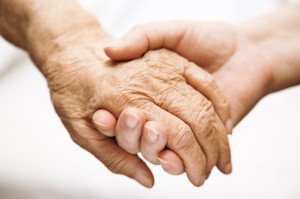
On one of my visits to Tennessee from Colorado to visit my mother at her assisted living facility, the two of us started down the hall to go to the dining room for dinner. Holding onto the railing that ran along one side of the wall with her right hand, Mom reached her left hand out to grab hold of mine. “Somehow I always feel better when you’re here to hold my hand,” she said, as down the hall we went.

I knew that feeling all too well. When I was a little girl and Mom took me downtown to shop for a new Easter dress or back-to-school shoes, I felt better when she held my hand as we crossed the busy street. Going up those big tall stairs into the school where I would start kindergarten, I couldn’t have made it without her hand to steady me. All my life I’d found security in reaching out for her and knowing she was there for me. Now she was saying, “Take my hand again,” only it was she needing the reassurance, and me being asked to find the courage and the strength to provide it.

It’s not as if she was alone during the months between my visits. My two sisters were local and visited her frequently, and she was surrounded by other caregivers and friends in her facility. But Mom liked knowing all three of her “chicks” were home to roost, and so holding my hand gave her a special sense of security.

To say I was pleased to take her hand is an understatement, but most of us, if we are honest with ourselves, are reluctant to accept the role reversal it represents. We see signs of aging in our parents that startle or alarm us, but we dismiss them as momentary lapses or anomalies. After all, if we accept that we now have to be the one to make the decisions and carry the load, then we are relinquishing the security we’ve always found in relying on our parents to do that.

And our reluctance to accept the role reversal has nothing to do with our chronological age. Some of my friends lost their mothers at a young age and were involved in their care when they were only in their twenties or thirties. A special friend of my mom’s was in his eighties when his mother passed away in a nursing home.

Regardless of how old we are when the roles reverse, we just wish things could stay the way they were a bit longer. In the midst of so much uncertainty, holding hands is never a bad choice.

Filed Under: Take My Hand Again Tagged With: aging, assisted living, role reversal

My Mother’s Hands

March 15, 2012 by Nancy 4 Comments

I was blessed to be with my mother for two weeks before she passed away at 92, even though we lived thousands of miles apart. Sitting beside her bed I found myself drawn to her hands—wanting to touch them and hold them as long as I possibly could.

These were the hands that cared for me when I was little and reached out for me when we crossed the street—both when I was small and carefree and when she was old and frail. These were the hands that created the home my two sisters and I remember so fondly…the hands that stirred the gravy, tied the bows on the backs of our dresses, decorated the Christmas tree, and folded the laundry.

On family vacations my Mom would lay her arm across the back of the front seat where she sat with my Dad, tapping her fingers in time to the music on the car radio or to the songs she was teaching us. I remember marveling at her long red nails and sparkly rings and thinking my Mom’s hands had to be the most beautiful hands in the world!

As she aged arthritis took its toll on Mom’s hands, but they were still beautiful to me because they were the hands that clapped excitedly whenever she first saw me on one of my visits to Tennessee from Colorado. And when she wanted to call her three daughters together one last time, and it was so difficult for her to speak, she motioned to us with her hands. Saying, “I want one, two, three” as she pointed to three spots on the foot of her bed, she indicated she expected us all to be present at once. When we were assembled, in an incredible and memorable blessing, she told us how much she loved us, how proud she was of us, and thanked us for taking good care of her in her old age. Then she sang the words “He touched me” from the old hymn, and simply said the word “peace.”

Mom lingered for two more days but never really spoke or opened her eyes again. She had said her goodbyes. As I sat by her bed after she had slipped away, I was still holding her hand and wondering how I could ever let it go.

But the Lord knew that day would come and thought of a way to comfort my sisters and me in it even as He was creating us in our mother’s womb. For you see, when we look at our own hands they remind us of our mother’s in so many ways. With hearts full of the love Mom gave us, and still gives us from heaven, we are left to carry on with our children and grandchildren. The work of her hands is now ours to do, and by God’s grace we will do it joyfully as we celebrate her life and the legacy she left us every day we live.

Filed Under: Take My Hand Again Tagged With: aging, hands, mother

Assisted Living Camp

March 15, 2012 by Nancy Leave a Comment

After an agonizing period of decision-making, my two sisters and I checked my mom into an assisted living facility. The day we took her to her new apartment, we kept sensing we’d experienced it all before.

This made no sense until one sister exclaimed, “I know what it is—it’s just like dropping a kid off at camp!” I don’t want to seem disrespectful to the aging in the least, after all we are the next generation headed toward assisted living, but the similarities are poignantly amazing.

Seeing an attractive woman seated in the hallway, we steered our mom in that direction. “She looks nice, Mom. Why don’t we go over and meet her? Maybe she plays bridge.” How like the efforts parents make to ensure their children make new friends at camp.

Concerns and complaints about the food in the dining hall are certainly similar, as is the clothing situation. My mother-in-law was in assisted living in our hometown, so I was the one charged with trying to keep up with all her laundry—a frustrating and fruitless endeavor. The only solution was to make sure her name was boldly imprinted on every single piece of clothing, sheet or pillowcase—just like at camp.

We expect our kids to participate in camp activities, and we hope our moms in assisted living will engage as well. In an effort to encourage my mom-in-law, I decided to join in one of the activities. Several times I called and reminded her that I was coming on Monday for the apple butter festival. I entered her room with a cheerful, “Hi! I’m here for the festival. Are you ready to go?” She replied, “I’m not going to that. Why are you going?” In this, as in many aspects of what my ninety-year-old friend mistakenly calls “assumed living,” it helps to keep a sense of humor.

But there are serious comparisons, too. We entrust our children to the care of camp counselors, but we can’t help but wonder if they are alright in the middle of the night. How often I woke up wondering if my mother and mother-in-law were truly safe. Was someone sneaking into their rooms to rob them of their few personal possessions? Had they fallen out of bed unable to call for help? At such times, whether with kids at camp or moms in assisted living, the best thing we can do is pray. In both cases, we send them off with our good intentions—and a whole lot of faith.

Filed Under: Take My Hand Again Tagged With: assisted living, elder care

  • « Go to Previous Page
  • Go to page 1
  • Interim pages omitted …
  • Go to page 5
  • Go to page 6
  • Go to page 7

Primary Sidebar

Subscribe to receive Nancy’s posts.
Loading

Recent Blog Posts

  • Are You Feeling Egg-centric?
  • For the Love of Hearts
  • Gentle and Lowly
  • Seek the Sun
  • We Pledge Allegiance

Categories

Blog Network

TheHighCalling.org Christian Blog Network 
  • Facebook
  • Instagram

Nancy Parker Brummett© 2026 · Methodical Webworks · Log in